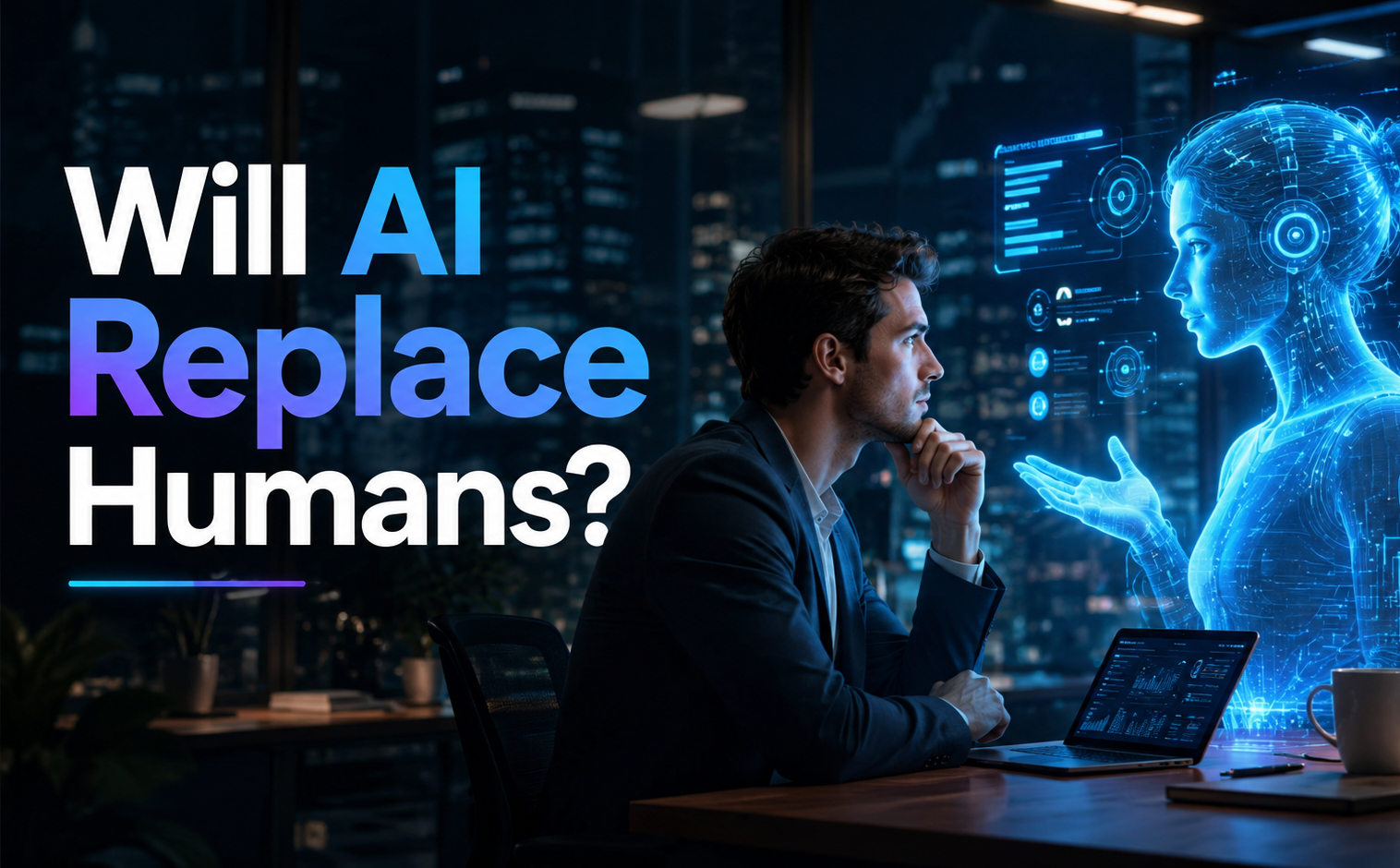
AI Is Not Killing Jobs, It’s Upgrading Work
“Will AI take my job?” If you’ve asked yourself this question recently, you’re not alone. From students to seasoned professionals, fear of artificial intelligence replacing human workers has spread faster than any virus. But here’s the truth that most clickbait headlines won’t tell you: AI is not here to fire you—it’s here to upgrade you.
Think of AI not as a robot stealing your desk, but as a power tool in your hands. A hammer doesn’t build a house by itself; a skilled carpenter does. Similarly, AI doesn’t replace people—it replaces repetitive tasks, freeing us to do more meaningful, creative, and strategic work. In this article, we’ll explore how AI and jobs are evolving together, why AI replacing jobs is a myth when you look at real numbers, and how the future of work with AI is brighter than ever.
Whether you’re a content creator, coder, teacher, marketer, or designer, you’ll learn how AI upgrading work is already happening around you. And most importantly, you’ll walk away feeling motivated—not scared—about your career.
The Fear vs. The Reality: What History Teaches Us
Every technological revolution has sparked the same panic. When tractors replaced plows, farmers feared starvation. When computers arrived, typists feared obsolescence. But what actually happened? We produced more food with fewer people, which gave birth to new industries like food logistics, biotechnology, and environmental science. Typists learned to become digital administrators, data analysts, and IT support.
According to a 2023 report from the World Economic Forum, 75 million jobs may be displaced by AI and automation by 2025—but 133 million new roles will emerge. That’s a net gain of 58 million jobs. The problem isn’t the technology; it’s the skills gap. And that gap is bridgeable with curiosity and willingness to learn.
So, when you hear “AI replacing jobs,” remember: it’s replacing tired, repetitive parts of jobs. It gives you back hours of your day to focus on what humans do best: solve problems, build relationships, and innovate.
How AI Upgrades Work Across Different Professions (Real Examples)
Let’s get practical. Here’s how AI and jobs are cooperating in six major fields. These examples prove that human and AI collaboration is the real story of our decade.
1. Content Creation: From Writer’s Block to Infinite Drafts
Writers and bloggers once feared AI-generated text. But today, smart creators use AI tools like Jasper, Copy.ai, or even ChatGPT to brainstorm headlines, outline articles, and rewrite clumsy sentences. Does this replace writers? No. It replaces the agony of staring at a blank page. The writer remains in charge: choosing the angle, injecting personality, fact-checking, and adding emotional depth. AI productivity in content means you can publish more high-quality work while spending less time on grunt work.
Real story: A freelance blogger used to spend 6 hours on a 2,000-word article (research + writing + editing). Now, with AI assistants, research time dropped by 60%. She uses the extra hours to interview experts and add original insights—making her articles 10x more valuable to clients.
2. Coding: From Bug Hunting to Creative Architecture
Developers know that coding is 20% writing and 80% debugging, reading documentation, and testing. AI coding assistants like GitHub Copilot or Amazon CodeWhisperer autocomplete lines, suggest functions, and even detect bugs. Does that mean jobs after AI for programmers disappear? No. Junior developers become more productive, and senior developers focus on system design, security, and user experience—things AI still can’t handle.
Key insight: AI doesn’t understand business logic or user empathy. It just predicts code. Software engineers who embrace AI tools for work become 2–3x more efficient and are paid more, not less.
3. Customer Support: No More Angry Repetition
We’ve all been frustrated by chatbots. But modern AI-powered support (like Zendesk Answer Bot or Intercom) handles common questions: password resets, order status, shipping times. This leaves human agents to deal with complex, emotional, or high-value issues. Customer satisfaction rises because humans aren’t exhausted by monotony.
Example: A telecom company introduced AI pre-screening for support tickets. Human agents now spend 80% of their time solving real problems instead of copy-pasting answers. Turnover dropped, and employee happiness soared.
4. Design: From Blank Canvas to Rapid Prototyping
Graphic and UX designers once spent hours on repetitive tasks like resizing images, generating color palettes, or creating multiple versions of a logo. Tools like Canva’s AI, Adobe Firefly, and Midjourney generate drafts in seconds. But a final logo? A beautiful brand identity? That still requires human taste, cultural understanding, and client communication. Designers using AI report producing 3x more concepts per day, winning more pitches.
Motivation for students: Learning design + AI tools makes you a hybrid creative—the most sought-after professional in the AI future careers market.
5. Education: Personalized Tutoring for Every Student
Teachers are overworked and under-resourced. AI doesn’t replace them—it gives them superpowers. Tools like Khanmigo (by Khan Academy) help create personalized lesson plans, grade assignments, and even tutor students 24/7. Teachers can then focus on mentoring, emotional support, and sparking curiosity. A classroom with AI is a classroom where no child is left behind.
Real impact: One middle school in Texas used AI to auto-generate math problems at three difficulty levels for each student. The teacher spent her time leading small group discussions. Test scores improved 22% in one semester.
6. Marketing: From Guessing to Predicting
Marketing used to be about gut feelings. Now AI analyzes customer behavior, predicts trends, and even writes ad copy variations. But strategy, brand storytelling, and ethical decisions? That’s all human. Marketers using AI tools report higher ROI and lower burnout. AI productivity allows small teams to compete with giant corporations.
Example: A 5-person marketing agency used AI to analyze 10,000 customer reviews and automatically generate personalized email campaigns. They saved 40 hours a week and tripled their client retention.
Why Productivity = Job Security in the AI Era
Here’s a hard but liberating truth: companies don’t fire people because they have AI. They fire people because those people cannot deliver value faster than AI. But if you learn to use AI, your value multiplies. A single content writer with AI can produce the output of a 3-person team. That writer becomes indispensable, not disposable.
Think of AI as a bicycle for the mind (Steve Jobs once described computers that way). With a bicycle, a human moves more efficiently than any other animal. With AI, a knowledge worker can research, analyze, and create faster than ever before. The future of work with AI belongs to those who ride the bicycle, not those who fear it.
- More creativity: AI handles data entry, scheduling, and documentation. You handle ideas.
- Better decisions: AI spots patterns in big data. You add judgment and context.
- Continuous learning: AI can teach you new skills in real time (language translation, coding basics, design principles).
When you embrace AI upgrading work, you stop worrying about job loss and start worrying about how much you can grow.
Future Trends: What the Next 5 Years Look Like
Let’s gaze into the crystal ball. Based on current research from Gartner, MIT, and LinkedIn’s Future of Work reports, here are three trends you’ll see by 2028:
Trend 1: “AI Literacy” Becomes as Essential as Typing
Just as typing was a special skill in 1990 and basic in 2020, AI prompting and collaboration will be expected for almost every white-collar role. Schools and bootcamps will teach “how to work with an AI coworker” as a core subject.
Trend 2: New Job Titles You’ve Never Heard Of
Already, we see roles like “Prompt Engineer” (salary $175k–$335k), “AI Workflow Designer,” “Algorithm Bias Auditor,” and “Human-AI Collaboration Manager.” The jobs after AI won’t be less—they’ll be more interesting and specialized.
Trend 3: Small Businesses and Solopreneurs Thrive
With AI handling accounting, marketing, customer service, and design, a single person can run what used to require a team of 10. This democratization means more opportunities for students and beginners to start their own ventures with low risk.
Takeaway: Don’t ask “Will AI replace me?” Ask “What new thing can I build with AI?”
Frequently Asked Questions (FAQ)
These are the most common questions people search on Google about AI and jobs.
1. Is AI really replacing jobs in 2026?
AI is replacing some tasks, not entire jobs. For example, data entry tasks are being automated, but the roles that used to do only data entry are evolving into data analysis or AI supervision. According to the WEF, AI will create more jobs than it removes by 2026.
2. Which jobs are safe from AI?
Jobs requiring high emotional intelligence, creative strategy, complex negotiation, hands-on skilled trades (electricians, plumbers), and in-person care (nurses, therapists, teachers) are very safe. Also, any role that uses AI tools for work becomes more valuable, not less.
3. How can a beginner start learning AI skills?
Start small: use free tools like ChatGPT, Canva AI, or Microsoft Copilot in your daily tasks. Then take free courses (Google’s “AI for Everyone”, IBM’s AI fundamentals on Coursera). Focus on “prompt engineering” – how to give clear instructions to AI. No coding required initially.
4. Will AI replace programmers?
No. AI helps programmers write code faster, but it can’t understand business requirements, negotiate trade-offs, or architect large systems. The demand for software engineers is still growing. However, programmers who refuse to use AI will be less competitive than those who embrace it.
5. What is the future of work with AI for students?
Students today will enter a workforce where AI handles routine tasks, so they can focus on creativity, collaboration, and problem-solving. The best preparation is to learn a skill you love (writing, coding, design, teaching) AND learn how to amplify it with AI. Hybrid skills = job security.
Don’t Let Fear Steal Your Future
I want to tell you a quick story. In 1980, when ATMs were introduced, bank tellers panicked. Newspaper headlines screamed, “ATMs killing bank jobs!” Over the next 20 years, the number of bank teller positions in the US doubled. Why? Because ATMs handled cash withdrawals, which allowed banks to open more branches. Tellers then focused on customer relationships, sales, and complex transactions. The job changed. It didn’t disappear.
The same is happening with AI today. The difference? This time, the upgrade is even faster. So you have a choice. You can spend your energy being afraid of AI replacing jobs, or you can spend that energy learning how to work alongside AI. One path leads to frustration. The other leads to a career with less grunt work, more creativity, and higher value.
You are not obsolete. You are not behind. You are exactly where you need to be to take the next step.
Conclusion: Upgrade Yourself, Upgrade Your Work
AI is not killing jobs; it's upgrading work. That’s not just a catchy headline—it’s the pattern of every technological revolution. From farming to factory to the digital age, humans have always adapted. Today, adaptation means becoming an AI collaborator, not a competitor.
We’ve seen how AI and jobs coexist in content creation, coding, support, design, education, and marketing. We’ve learned that AI productivity isn’t about replacing humans; it’s about amplifying us. And we’ve looked at the future of work with AI—a future full of new roles, higher satisfaction, and opportunities for anyone willing to learn.
So here’s my challenge to you: this week, pick one AI tool related to your field. Spend one hour learning it. Use it to complete one task that used to frustrate you. See how it feels. I promise you, the fear will melt away, replaced by excitement. The jobs after AI era is not something to survive—it’s something to thrive in.
Go upgrade yourself. The future of work is waiting for you, not against you.




Leave a Comment
No comments yet. Be the first to share your thoughts!